
Handle-less Cabinetry, Fluted Panels, and the Finishes Defining Luxury Joinery in 2026
Design trends in residential joinery move slowly — and that's appropriate for a product category that lasts decades and sits at the heart of a home's daily life. The finishes and details that define luxury joinery in 2026 are not dramatic departures from recent years, but they represent a clear consolidation of aesthetic directions that have been building in the market and a deepening sophistication in how those directions are being executed.
This is a reference guide for architects and interior designers who are specifying joinery for premium residential and multi-residential projects in Australia in the current market.
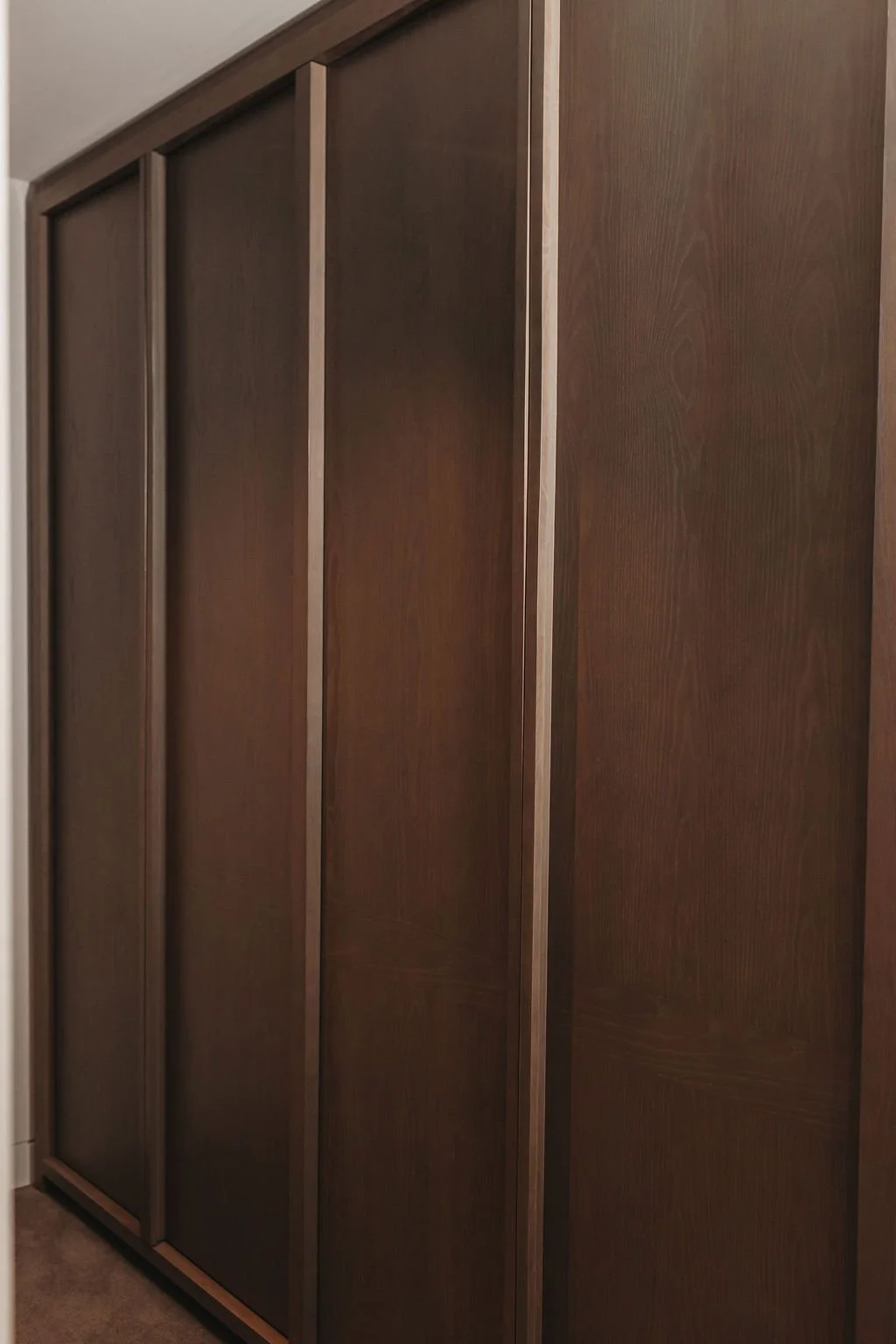
The Rushcutters Display
Handle-less joinery: still the dominant language of luxury
Handleless cabinetry — whether achieved through integrated finger pulls, push-to-open mechanisms, or recessed grip profiles — has consolidated its position as the default specification language for luxury joinery in Australia. It is no longer a trend choice; it is the expected baseline for premium projects.
What has evolved is the sophistication of the handleless detail. The basic J-pull profile that defined handleless kitchens in the early part of the decade is now being replaced by more resolved details: a continuous routed channel that wraps the full perimeter of a door, a recessed timber or metal grip integrated into the door face, or a minimal finger pull machined directly into the substrate with no separate profile at all.
The implication for specification is that handleless joinery is not a single decision but a series of detailed design decisions — each of which affects the visual weight, the material palette, and the manufacturing complexity of the joinery package. Early engagement with your joinery contractor on the specific handleless detail is important: not all details are equally achievable at all price points, and some require specialist machinery or tooling.
Fluted and reeded panels: texture as a design strategy
The fluted panel has become one of the most widely specified surface treatments in luxury residential joinery across Australia — appearing on island fronts, full-height pantry doors, bathroom vanity faces, and feature joinery in common areas of apartment buildings.
The appeal is clear: fluting adds texture, depth, and a sense of handcraft to what would otherwise be a flat surface. It catches light differently across the day, producing a surface that reads dynamically rather than statically. And it references a material language — architectural mouldings, reeded columns, woven textiles — that carries genuine historical weight without being retrograde.
The specification challenge with fluted panels is consistency. Fluting is machined into the substrate, and any variation in profile depth or spacing is visible across a long panel in raking light. For multi-residential applications, where fluted panels need to be consistent across hundreds of doors, the manufacturing process needs to be precise and well-controlled.
Fluting works best when it is resolved as part of the full design: the profile should be scaled in relation to the door dimensions, the spacing should be considered in relation to adjacent elements, and the finish — typically a single colour that reads uniformly across the fluted surface — should be chosen to work with the lighting conditions of the space.
Natural veneer: the move away from imitation
Real timber veneer has been gaining ground in premium joinery specifications as designers and buyers become more sophisticated about distinguishing natural materials from their synthetic approximations. The improvement in timber-look laminates has been significant, but at close range and in high-quality lighting conditions, real veneer still reads differently — with a depth, warmth, and variation that reflects its origin.
The species being most widely specified in Australian luxury joinery currently include American white oak, European ash, walnut, and blackened or limed versions of the above. Quarter-cut veneer — with its linear, consistent grain pattern — continues to dominate for joinery applications where a refined, architectural quality is sought. Crown-cut veneer, with its more dynamic figure, is appearing more frequently in feature applications where material character is part of the design intent.
The practical considerations for veneer specification remain: batch consistency, edge treatment, appropriate sealing, and maintenance requirements. These are best discussed directly with your joinery contractor before the specification is finalised.
Colour: the quiet shift toward depth
The dominant colour direction in luxury Australian joinery in 2026 is a move away from pure white and toward warmer, more complex neutrals — warm whites with a grey or putty undertone, greige, soft sage, and deep forest tones that read as grounded and considered rather than stark.
At the same time, there is a growing appetite for depth and drama in feature joinery — deep charcoal kitchens, navy bathroom vanities, forest green island benches. These choices are appearing most often in boutique apartment developments and high-end renovations where the joinery is intended to be a design statement, not a neutral backdrop.
The specification implication is that colour needs to be confirmed in the actual space, under the actual lighting conditions of the project — not just from a sample board in a showroom. Ask your joinery contractor to provide a painted sample or a full-size mock-up panel in your specified colour before committing to the full production run.
Integrated metal details
One of the more distinctive directions in current luxury joinery is the integration of metal elements — brushed brass, blackened steel, matte black aluminium — as part of the joinery itself rather than simply as hardware. This appears as metal-faced drawer fronts, metal edge inserts on shelf fronts, metal frame details around glass-fronted cabinet doors, and metal finger pull profiles integrated into the door face.
These details are expensive and require specialist manufacturing capability, but they produce a result that is genuinely distinctive and difficult to achieve in any other way. When specified well, metal integration makes joinery feel more like furniture — a quality that resonates strongly in the premium residential market.
Creador's approach to trend and specification
At Creador, we stay closely attuned to the material and design directions shaping the Australian luxury joinery market — not to follow trends, but to ensure that our specification advice and manufacturing capability are always ahead of what our clients are asking for. When you're designing a project that will be built next year and lived in for decades, you need a joinery partner who can tell you not just what's possible, but what will endure.

📩 Contact us to request a joinery proposal or explore our past projects.
Thank you for reading - Digital Marketing Team