
How to Specify Joinery Finishes That Hold Up Across 100+ Apartments
Finish selection for a single bespoke home is a design exercise. Finish selection for a 120-apartment development is a risk management exercise — one where the wrong decision can produce thousands of metres of inconsistent, difficult-to-replace cabinetry installed across a building that's already been sold.
The consequences of a finish specification that fails at scale are significant: buyer complaints, defect claims, costly remediation during the defect liability period, and reputational damage for the developer and builder alike. And yet finish selection in many multi-residential projects is still made on the basis of how a sample board looks under a showroom light — without proper consideration of how that finish will perform through manufacturing at volume, installation, and years of daily use.
This guide covers the key considerations for developers and builders specifying joinery finishes for large apartment packages.
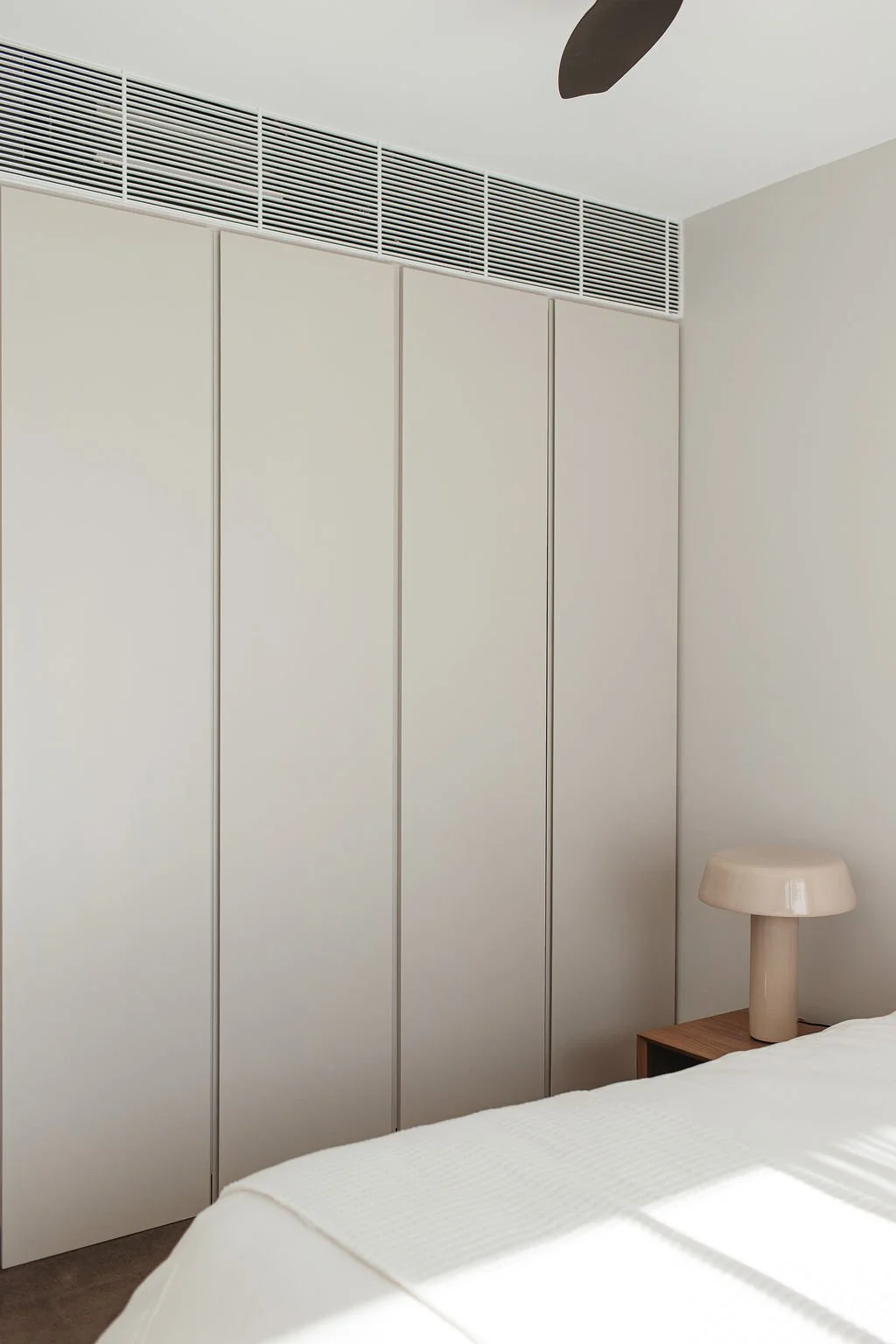
The Rushcutters Display
The five dimensions of a finish specification
When evaluating a joinery finish for use across a large apartment development, there are five dimensions that matter — not just appearance.
1. Batch consistency
Natural and semi-natural materials — timber veneer, stone veneer, some textured laminates — vary between batches. What looks consistent across two sample boards can show visible variation when installed across 30 apartments on the same floor. Before specifying any finish with natural variation, confirm with your joinery contractor how batch consistency will be managed across the full production run, and ask to see evidence of consistency across a comparable project.
Synthetic laminates from major Australian suppliers (Laminex, Polytec, Formica) are engineered for batch consistency and are generally the safer specification choice for large volumes where consistency is critical.
2. Availability and lead times
Some premium finishes — particular veneer species, specialist surface textures, exclusive colour ranges — have limited availability and long lead times. In a multi-residential programme, where your joinery contractor needs to order the full volume at the commencement of manufacturing, a finish that goes on backorder or is discontinued mid-project creates a serious problem.
Before locking in your finish specification, confirm current availability, lead times, and minimum order quantities with your contractor. Identify an approved alternate for every critical finish in case of availability issues.
3. Durability in residential use
Not all finishes that look beautiful perform equally well under the conditions of daily residential use. Kitchen cabinetry takes significant daily punishment: moisture, heat, impact, and repeated contact. A finish that performs well for years in one application can fail quickly in another.
High-pressure laminate (HPL) consistently outperforms standard thermally fused melamine in durability testing and real-world performance. 2-pac polyurethane offers excellent durability when properly applied and cured. Veneer requires appropriate sealing and is more sensitive to moisture — it should be specified in kitchen applications with care and always with an appropriate protective finish coat.
4. Cleanability and maintenance
For an apartment product, consider how the finish will be maintained by a tenant or buyer who may not be as careful as you'd hope. Matte finishes, while aesthetically popular, show fingerprints and smudge marks more readily than mid-sheen alternatives and can be more difficult to clean without leaving marks. High-gloss finishes show scratches and dust more readily.
The optimal finish for maintainability in a residential apartment is typically a low-sheen or satin surface — whether laminate, 2-pac, or veneer — that reads as premium without being demanding to maintain.
5. Compatibility with hardware and edging
Your finish choice has implications for hardware finish and edging treatment. A warm timber veneer door needs a handle finish and edge treatment that complements the material — brushed brass hardware and a timber edge strip, for example — rather than the brushed nickel and ABS edging that might be appropriate with a white laminate. These relationships need to be considered holistically, not specified in isolation.
The finish combinations that are defining Melbourne and Sydney apartments in 2026
The most widely specified finish combinations in premium Australian apartment developments currently include warm white or greige 2-pac or laminate with brushed nickel hardware and integrated finger pulls; natural oak or ash veneer with matte black hardware and a tonal edge treatment; and deep charcoal or forest green laminate with brushed brass hardware as a feature kitchen specification in boutique developments.
Fluted and reeded panel profiles — applied to island fronts, full-height pantry doors, and bathroom vanity faces — continue to gain traction as a way of adding texture and depth to an otherwise flat laminate or 2-pac specification.
How Creador manages finish specification for large packages
At Creador, we work with developers and builders from the finish selection phase — providing sample boards, mock-up panels, and technical advice on availability, consistency, and performance for every finish we recommend. We don't just supply what's specified; we contribute to making the specification better.
Our manufacturing process includes batch consistency checking for all large-volume runs and pre-shipment inspection to confirm finish quality before containers are loaded. If there's a finish discrepancy, we want to find it at the factory — not on your site.

📩 Contact us to request a joinery proposal or explore our past projects.
Thank you for reading - Digital Marketing Team