
Joinery Material Selection: A Practical Guide for Architects and Interior Designers
The materials you specify for a joinery package have a profound effect on the final result — not just aesthetically, but structurally, functionally, and in terms of how the joinery performs over years of daily use. A material that looks beautiful in a sample board can cause problems in manufacture, installation, or long-term durability if it isn't well matched to the application.
This guide is intended as a practical reference for architects and interior designers specifying joinery for residential and multi-residential projects in Australia. It covers the key material categories — substrates, face finishes, hardware, and edging — and the considerations that should inform your choices at each stage.
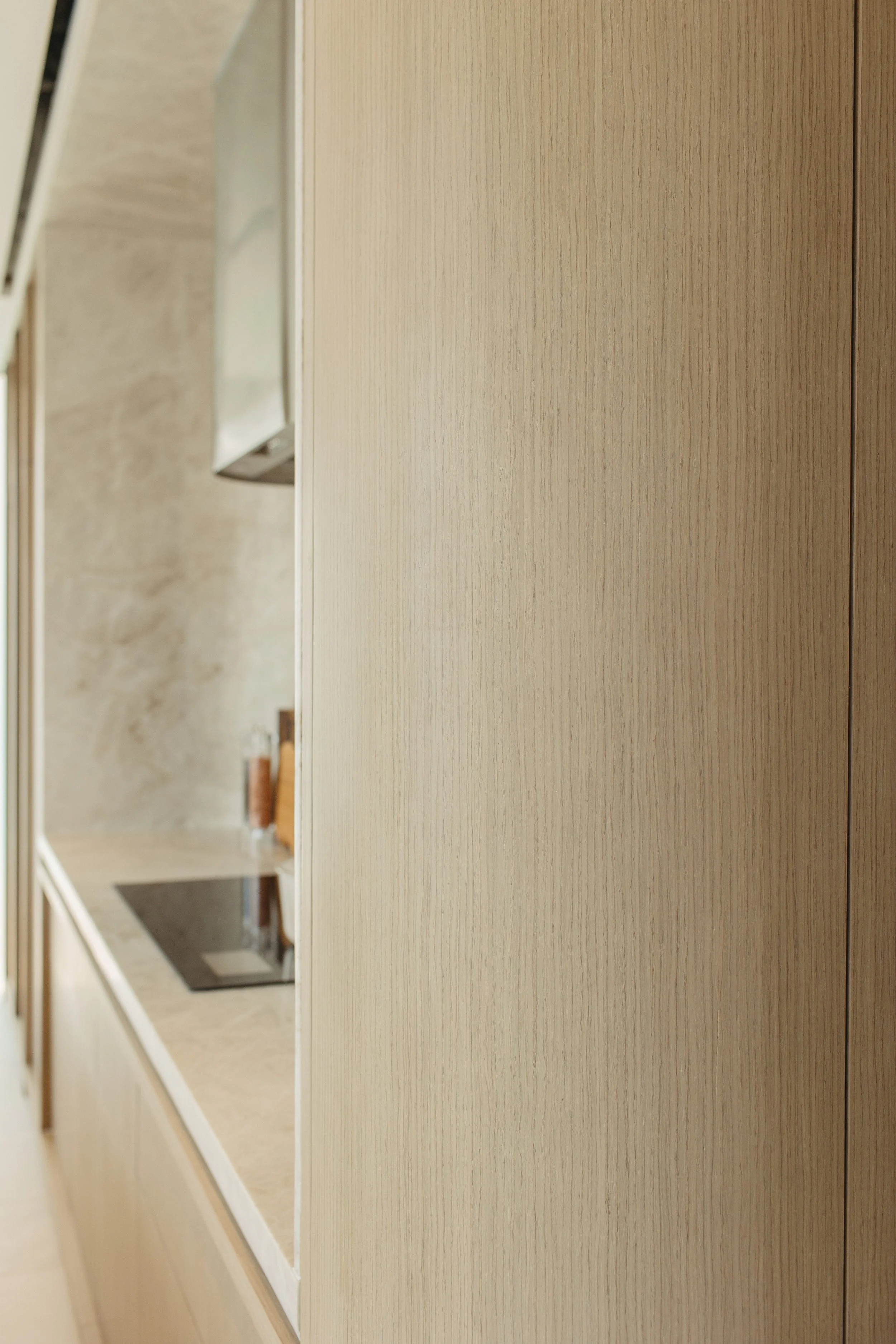
The Rushcutters Display
Substrates: what's behind the finish
The substrate is the structural core of any joinery element — the material from which carcasses, doors, and drawer boxes are constructed. It's invisible in the finished product, but it determines the joinery's structural integrity, moisture resistance, and long-term performance.
Moisture-resistant particleboard (MR board)
The standard substrate for kitchen and bathroom joinery in Australian residential projects. MR board is cost-effective, dimensionally stable, and performs well in environments with moderate humidity when properly sealed at edges and joins. It should be specified for all joinery in wet areas, laundries, and kitchens as a minimum.
Medium-density fibreboard (MDF)
MDF offers a smoother, more consistent surface than particleboard, making it the preferred substrate for painted finishes, routed profiles, and detailed door styles. It is denser and heavier than particleboard, which is relevant for large-format doors and panels. Standard MDF is not suitable for wet areas — moisture-resistant MDF (MR MDF) should be specified where humidity is a concern.
Plywood
Structural-grade plywood is increasingly specified for premium joinery, particularly for carcasses in high-use applications such as kitchen base cabinets and drawer boxes. It offers superior screw-holding ability and structural rigidity compared to particleboard, and holds up better to moisture ingress at joins. It is also the preferred substrate for projects where a natural edge detail is part of the design language.
Face finishes: the visible layer
Laminate (high-pressure and thermally fused)
Laminate remains the most widely specified face finish for residential joinery in Australia. It is durable, available in an enormous range of colours and textures, relatively easy to maintain, and cost-effective at scale. High-pressure laminate (HPL) — brands such as Laminex, Polytec, and Formica — is applied to doors and panels with an adhesive bond and offers superior durability compared to thermally fused melamine (TFL), which is bonded under heat and pressure directly to the substrate.
For multi-residential projects, laminate is often the optimal finish choice: consistent batch-to-batch, widely available, and proven in high-use environments.
Timber veneer
Real timber veneer delivers a warmth and authenticity that no laminate can fully replicate, and it continues to be widely specified in premium residential and boutique apartment projects. The key considerations for veneer specification at scale are: batch consistency (veneer is a natural material and will vary), edge treatment (veneer edges require careful detailing to avoid telegraphing the substrate), and maintenance (veneer requires appropriate sealing and is more sensitive to moisture and impact than laminate).
Specify veneer with a clear reference to species, cut (crown cut, quarter cut, or rift cut), and finish (oiled, lacquered, or raw). Vague veneer specifications produce variable results.
Painted finish
A painted MDF door or panel, properly prepared and finished, can achieve a result that is difficult to distinguish from a factory-sprayed premium product. For contemporary interiors where a clean, matte surface is the design intent, painted joinery is often the right choice. Key considerations are film thickness, sheen level (flat, low-sheen, or satin), and the specification of a primer coat to prevent grain raise on MDF.
2-pac polyurethane
2-pac polyurethane is the premium painted finish for joinery — a two-component catalysed finish applied in a spray booth that produces a hard, durable surface with an exceptional depth of colour. It is significantly more expensive than standard painted MDF but delivers a result that is genuinely superior in terms of finish quality and durability. Often specified for kitchens and bathrooms in high-end residential projects.
Edging: the detail that defines quality
The edging treatment on joinery doors and panels is one of the first things an experienced eye notices — and one of the clearest signals of quality. Standard ABS edging (0.4mm or 1mm) is the default, but there are several options worth knowing:
Postformed edges — where the laminate wraps continuously around a shaped edge profile — produce a seamless result with no visible join line. Commonly used on benchtops and shelf edges in contemporary joinery.
Timber edge tape — natural or engineered timber veneer applied as an edge strip — is frequently used to complement a veneer face finish and add warmth to a panel edge.
Lacquered MDF edge — where the MDF substrate itself is shaped and lacquered to produce a clean, minimal edge detail, often used in painted joinery to eliminate the visible dark line of a standard ABS strip.
Hardware: the element that determines the experience
Hardware is the interface between the user and the joinery — and it's where the perception of quality is formed more than almost anywhere else. Soft-close hinges and drawer runners are the minimum standard for residential joinery in 2026. Beyond that, the key considerations are:
Brand and range consistency — specify a single hardware brand and range across the project. Mixing brands produces visual inconsistency and can create compatibility issues.
Finish durability — brushed nickel and matte black finishes are widely specified and perform well in residential environments. Chrome finishes show fingerprints and water marks more readily. Confirm the durability rating of any decorative hardware in wet-area applications.
Handle vs handleless — handleless joinery (using integrated finger pulls or push-to-open mechanisms) continues to dominate premium residential specifications. If specifying handleless, confirm the mechanism type with your joinery contractor early — different systems have different implications for door and drawer sizing.
Working with Creador on material selection
At Creador, we work with architects and interior designers throughout the material selection process — providing sample boards, finish mock-ups, and technical advice on what's achievable within your programme and budget. We believe material selection is best approached as a collaboration, and we bring our manufacturing knowledge into the conversation to help you make decisions that look as good on site as they do on the sample board.

📩 Contact us to request a joinery proposal or explore our past projects.
Thank you for reading - Digital Marketing Team